


MICE is one of the most valuable opportunities in hospitality, but it’s also one of the most complex to manage.
Visit our MICE & Group Proposals dedicated page to see how you can make Interactive Proposals, track them & fix offer mistakes in seconds:
Meetings, incentives, conferences, and events are not simple room requests. A corporate client usually needs much more than accommodation. They may need meeting rooms, coffee breaks, business lunches, AV equipment transfers,and a clear proposal that brings everything together.

For hotels, this creates a major opportunity. A single MICE request can generate revenue from multiple departments at the same time:
accommodation, meeting spaces, food and beverage, AV services, transfers, wellness, activities, and additional guest services. But to win this business, hotels need to respond quickly, clearly, and professionally.
This is why hotels need a better way to manage MICE requests.
Traditional emails and static PDFs are no longer enough for a process that involves multiple layers. Hotels need structured RFP tools that help them turn a complex event request into a clear, professional, and interactive proposal.
Why MICE Is a High-Value Revenue Channel for Hotels?
MICE can create strong revenue opportunities because it combines several revenue streams in one request.
According to SiteMinder, MICE events can contribute around 20–30% of total hotel revenue for hotels that focus on the segment. In some cases as much as 40%.It also notes that more than 80% of surveyed hotels in APAC expect MICE revenues to continue growing. This shows that MICE is not just a side opportunity. For the right hotels, it can become a core revenue channel.
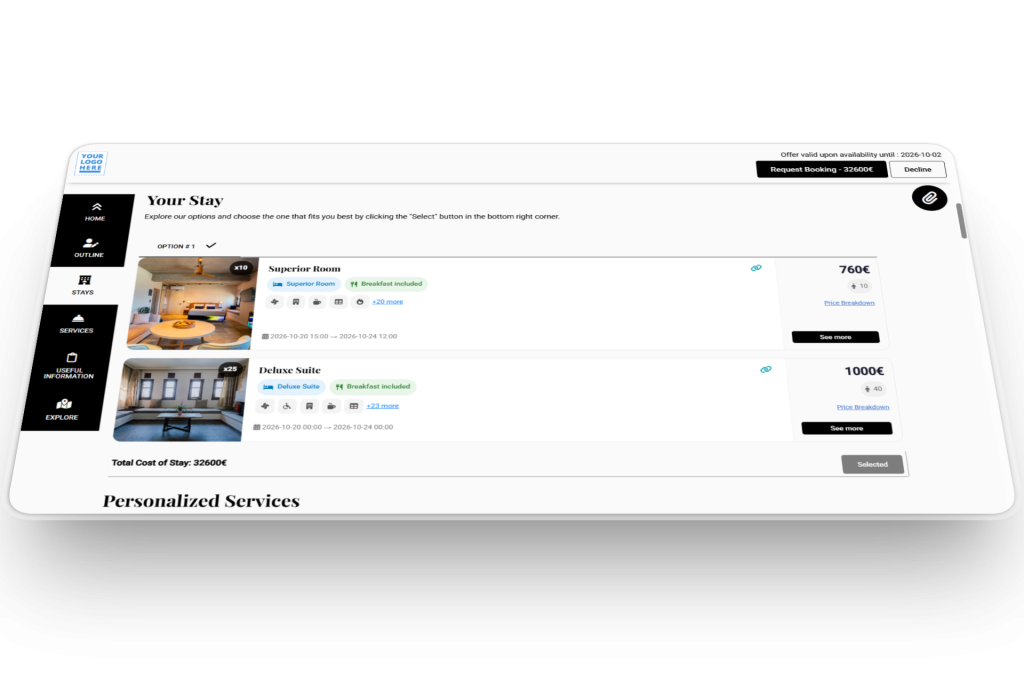
A corporate event may include meeting room hire, accommodation, catering, drinks, AV equipment, transfers, branding, welcome services, and additional activities. It can also help hotels fill mid-week or off-peak periods, when leisure demand may be lower. SiteMinder highlights this advantage clearly, noting that MICE bookings often create high-value advance business during quieter periods and bring together multiple revenue streams from a single client.
This makes MICE especially attractive for hotels that want to grow beyond standard room sales.
However, MICE clients do not only look for availability and price. They look for confidence. They want to know that the hotel can understand the brief, organize the details, coordinate the event smoothly, and present everything in a professional way.
A hotel is not only offering a venue. It is offering the entire event experience.
The MICE Market Is Becoming More Digital and Experience-Driven
The global MICE market is also becoming more digital, more sustainability-driven, and more experience-focused.
Converve’s MICE Tourism in 2026 guide highlights that Europe still holds the largest share of the global MICE market, around 51.7% in 2025, while Asia-Pacific is the fastest-growing region. This matters for European and Mediterranean hotels because competition is not only local anymore. Destinations and venues are competing for corporate demand in a more global and structured market.
The same guide points to several trends that are reshaping MICE: sustainability, hybrid formats, AI-driven personalization, second-tier destinations, purpose-driven incentives, and wellness-first programming. These are not only trends for event planners. They directly affect how hotels should present their MICE offer.
A modern MICE proposal should not only say “we have a meeting room.” It should show whether the hotel can support hybrid events, whether the meeting space is flexible, whether F&B options can support dietary and sustainability needs, whether the proposal includes floor plans, and whether the client can understand the full event journey without reading multiple attachments.
Why MICE Requests Are Harder to Manage Than Leisure Bookings?
A leisure booking usually focuses on rooms, dates, rates, upgrades, and guest experiences.
A MICE request is different. It may include a meeting room for 50 participants, a specific seating setup, two coffee breaks, a business lunch, microphones, projector, Wi-Fi, technical support, name badges, branding, group transfers, accommodation blocks, and a floor plan.
This means the hotel team has to coordinate several departments before sending the final proposal. Sales, events, reservations, F&B, operations, and technical teams may all be involved.
Les Roches describes hotel event management as a cross-functional role that requires coordination with hotel staff across departments, budget and timeline management, vendor relationships, AV equipment, event-day logistics, and client satisfaction. This reflects the reality of MICE inside hotels: the proposal is not only a sales document, but the beginning of an operational workflow.
When this process is handled manually, it becomes slow and difficult to control. Information can be scattered across emails, spreadsheets, PDFs, and internal messages. Pricing may need to be calculated manually. Attachments may be forgotten. Follow-up can become unclear.
For hotels, this creates unnecessary workload.For the client, it can create confusion.
What is a Hotel RFP tool?
RFP stands for Request for Proposal.
In hospitality, an RFP tool helps hotels manage structured requests from corporate clients, groups, event planners, and companies. Instead of responding manually with disconnected files and long email threads, the hotel can organize the event requirements, services, pricing, attachments, and proposal status in one workflow.
For MICE, an RFP tool should help the hotel answer the most important questions.
Most asked Questions:
What does the client need?
Which meeting room is suitable?
How many participants are expected?
What setup is required?
Which food and beverage services should be included?
What AV equipment is needed?
What is optional?
What is the price per person?
What is the total event cost?
What should the client do next?
The goal is not only to send a business proposal faster.The goal is to make the proposal clearer, more visual, and easier to approve.
The best way to manage MICE Proposals & Quotes
PDFs still have a role in MICE. They are useful for menus, floor plans, event terms, brochures, and technical details.
But the full proposal should not depend only on a static PDF.A static PDF is difficult to update after sending. It does not allow the client to select services, understand pricing dynamically, or interact with the offer. It also often requires several attachments, which makes the client experience heavier.
An interactive proposal is different.
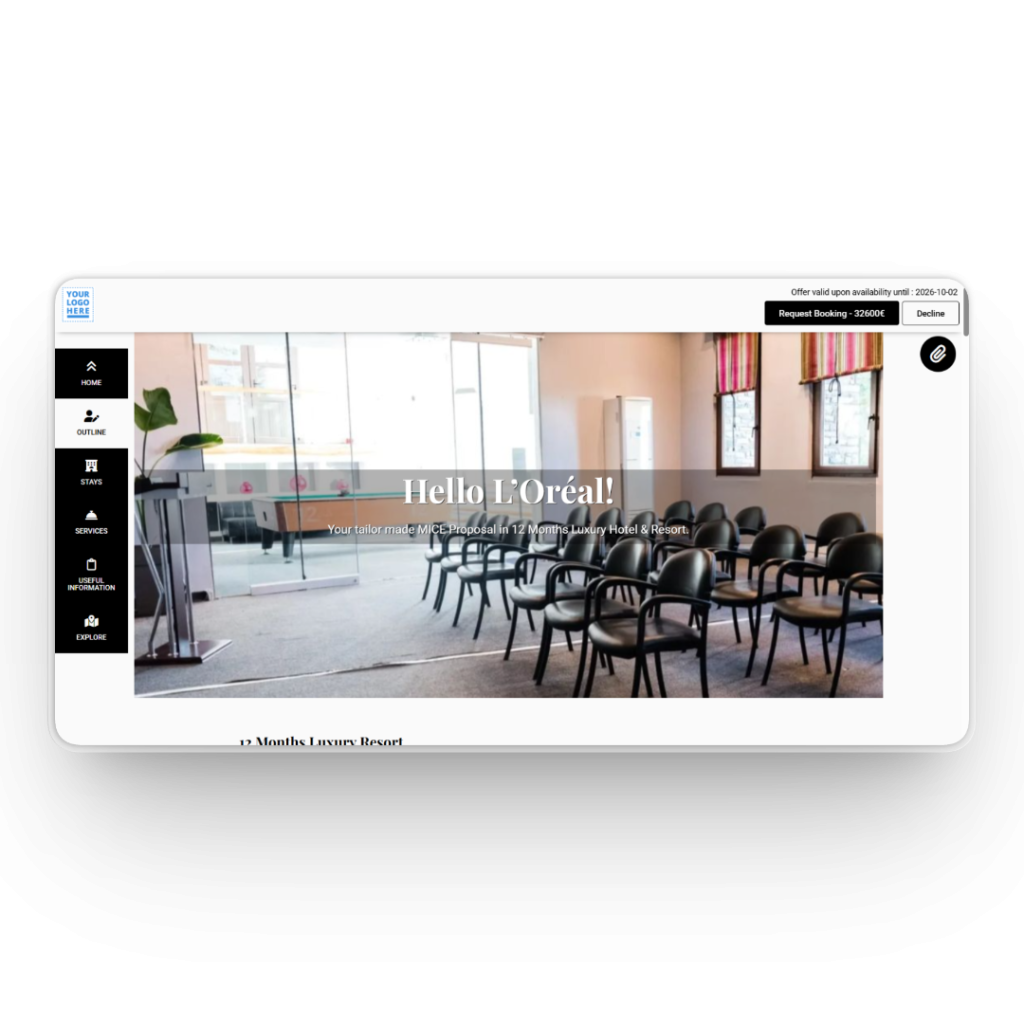
With an interactive proposal, the hotel can send one Personalised Email Template that will include a “View your Proposal Button” with the personalized link. Inside that link, the client can view the event overview, explore the meeting room, check service options, see photos, review floor plans, understand pricing, and submit a request.This creates a more modern and professional MICE sales experience.
What Every Hotel MICE Proposal Should Include?
A strong MICE proposal should begin with a clear event overview. The client should immediately see the company name, event name, event dates, number of participants, hotel contact person, proposal validity, and estimated total value.
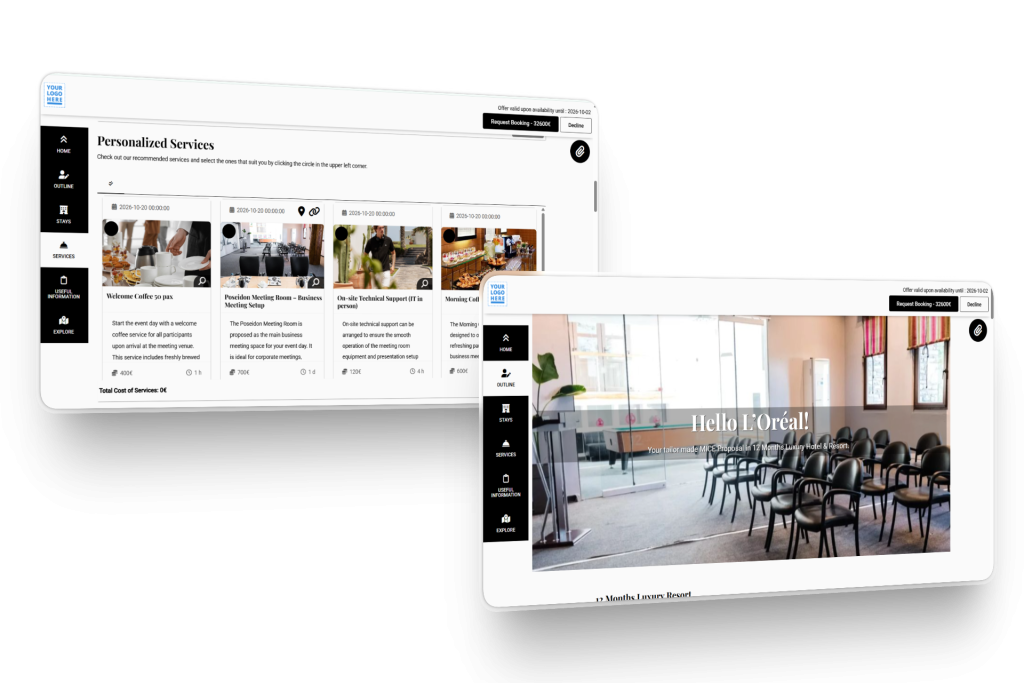
The meeting room section should include more than just the room name. It should show dimensions, capacity, setup options, AV possibilities, photos, and floor plan assets. For example, a meeting room such as Poseidon Meeting Room should be presented as an event space, not as a simple guest service.
Food and beverage should be presented in a clear and selectable way. Welcome coffee, morning coffee break, afternoon coffee break, business lunch, networking cocktail, and corporate dinner can all be shown as separate services. This helps the client understand what is included and what can be added.
Pricing should be transparent.
If a service is priced per person, the proposal should show both the unit price and the total price. For example, a morning coffee break may be calculated at €12 per person for 50 participants, with a total of €600. This avoids confusion and makes budgeting easier for the client.
The proposal should also include technical and operational services such as AV equipment, microphones, screen, Wi-Fi, hybrid meeting support, on-site technical assistance, registration desk, branding, name badges, transfers, and event coordination.
These details are not only operational.
They are also opportunities for the hotel to increase revenue and present a more complete event solution.
Why Sustainability Should Be Included in MICE Proposals?
Sustainability is no longer just a “nice to have” in MICE.
Converve reports that 88% of corporate travellers prefer to work with eco-conscious partners, 78% rate sustainability as extremely important when selecting venues, and 38% of event briefings already include an explicit ESG component.
This means hotels should make sustainability information easier to present inside MICE proposals.
A proposal could include local sourcing, waste reduction, refillable water stations, sustainable catering options, energy-conscious meeting spaces, green certifications, CSR activity options, or low-impact transfer suggestions.
For corporate clients, this information can support internal ESG goals. For hotels, it creates a stronger and more modern proposal.
In ETHERIA, sustainability details can be added as part of the event proposal flow. As a dedicated section in an extra section called “Useful Information” that you can write anything you want or as selectable services inside the MICE offer.
How Hybrid Events and AV Requirements Change Hotel Proposals?
Hybrid events are now part of the MICE standard.
Converve notes that hybrid event adoption grew by 20% in 2024, with more than three-quarters of event planners reporting higher client interest. It also explains that buyers now ask how on-site and virtual audiences will be connected, not simply whether hybrid is possible.
For hotels, this has a direct impact on proposals.
A MICE proposal should clearly show whether the hotel can support livestreaming, video conferencing, microphones, screens, projectors, reliable Wi-Fi, and technical support. These details should not be hidden in a long email. They should be visible inside the proposal as clear service options or technical notes.
This helps the client feel more confident and helps the hotel reduce last-minute operational problems.
Why Hotels Need a Dedicated MICE Proposal Workflow?
MICE proposals should not be mixed with simple guest proposals.
A leisure guest proposal and a corporate event proposal have different needs. The services are different, the pricing logic is different, the approval process is different, and the people involved are often different.
A hotel-friendly system should separate guest proposals, group proposals, and MICE proposals. This helps the sales and events team manage opportunities more clearly.
For MICE proposals, the dashboard should show the proposal name, company name, event dates, number of participants, proposal type, estimated value, status, and follow-up action. The proposal name should be visible immediately, without needing to open the proposal.
Status should also be easy to understand. Accepted proposals can be green, declined proposals red, sent proposals light blue or grey, follow-up needed yellow, drafts grey, and expired offers dark grey. This gives the hotel team a clear overview of the pipeline.
How Service Categories Make MICE Proposal Creation Faster ?
Hotels offer many different types of services, so the service library should be well organized.
- Before-arrival services,
- In-stay upselling,
- Cross-selling,
- Room upgrades,
- Transfers,
- Wellness,
- F&B, and
- MICE event services should not all be mixed together:
- For MICE, the event services category should include meeting rooms, coffee breaks, business lunch, AV packages, technical support, registration desk, corporate branding, event coordination, transfers, networking cocktails, and corporate dinners.
This makes it faster for the hotel team to build a proposal and reduces the chance of missing important services.
It also makes the platform easier to use. A hotel team should not need to search through spa treatments, room upgrades, transfers, and meeting rooms in the same unstructured list. The right service should be easy to find and easy to add to the right proposal.
Why Visuals, Floor Plans, and 3D Layouts Matter?
MICE clients need to visualize the event before they confirm it.
SiteMinder lists flexible spaces, modern technology rooms, event teams, food and beverage, pricing packages, room blocks, and sustainability credentials as important features of successful MICE hotels. It also highlights high-quality AV systems, fast Wi-Fi, presentation tools, and spaces that can support hybrid meetings and livestreaming.
For this reason, event services should support more than one image. A meeting room should be able to show the main room photo, theatre setup, boardroom setup, classroom setup, coffee break area, banquet setup, floor plan, and 3D layout.
ETHERIA also includes a dedicated analytics section where hotels can monitor proposal KPIs and revenue performance.
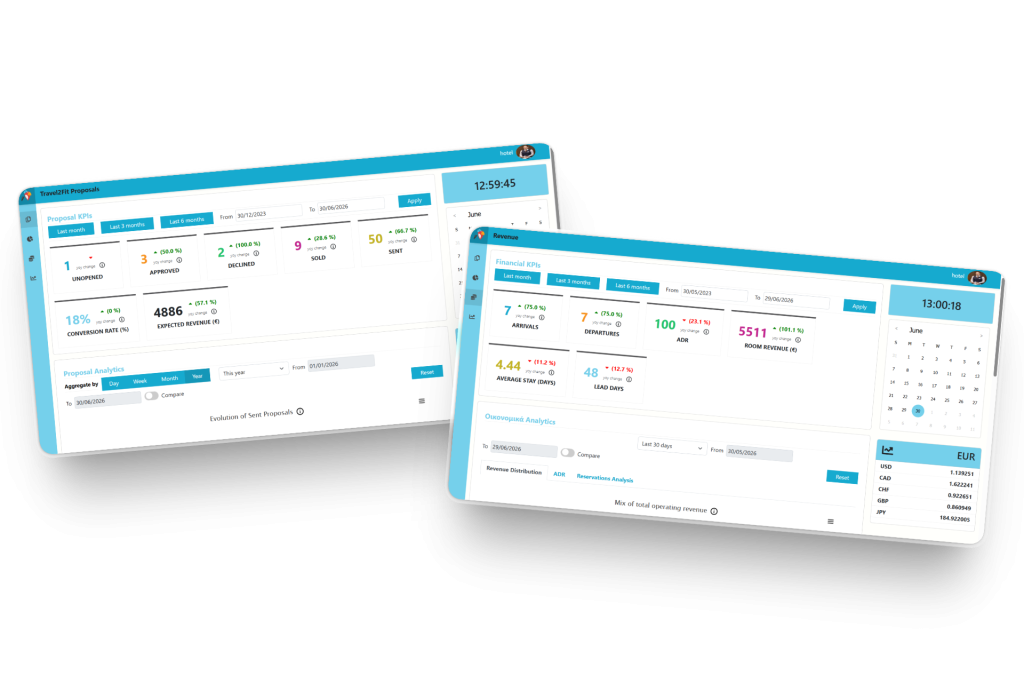
- Hotel teams can track key indicators such as arrivals, departures, ADR, room revenue, average stay, lead days, revenue distribution, and reservation performance.
- For MICE and group business, this helps hotels understand how proposals connect with revenue, which opportunities are performing better, and where follow-up is needed.
With ETHERIA, hotels do not only create interactive proposals. They can also measure their impact.
The main service card can remain simple, with one image and a short description. The expanded view can include the gallery, dimensions, capacity table, floor plan, inclusions, add-ons, and operational notes.
This keeps the UX clean while still giving corporate clients the detail they need.
Floor plans and 3D setup images are especially important because they help the client understand how the event will actually work. They can see where the screen will be placed, how guests will be seated, where the registration desk could go, and how the coffee break area connects to the meeting room.
This turns the proposal from a list of services into a visual event plan.
From AI Chatbot to Interactive MICE Proposal in Minutes
In MICE, timing and presentation matter.
Corporate clients and event planners often contact several hotels at the same time. The hotel that responds faster, with a clear and professional proposal, has a stronger chance of keeping the client’s attention.
A modern conference page should include an AI chatbot like ETHERIA AI Chatbot & widget that acts as the first step of the MICE sales journey. The chatbot can answer questions, guide the client through the event options, and collect the key information the hotel team needs.
This can include the event date, number of participants, preferred meeting room setup, food and beverage needs, accommodation requirements, AV support, branding, transfers, and contact details.
After that, the hotel team can use ETHERIA to create a fully interactive, clickable proposal in minutes.
Instead of building everything manually from scratch, the team can turn the structured request into a personalized proposal link with meeting rooms, coffee breaks, business lunch, AV equipment, floor plans, attachments, service pricing, and total event cost.
This is especially important in MICE because proposal preparation often takes time. Hotels may need to collect information from different departments, calculate pricing, prepare menus, attach floor plans, and write a complete response.
A process that takes too long can slow down the sales opportunity.By ETHERIA, the goal is to reduce this friction.
The AI chatbot helps collect the request. The RFP workflow helps structure the information. The interactive proposal helps present the offer clearly. The client receives one link instead of multiple scattered attachments.
This creates a faster and more professional experience for both the hotel team and the corporate client.
How ETHERIA Helps Hotels Manage MICE Proposals?
ETHERIA by Travel2Fit is designed as a sales and proposal layer for hotels.
It helps hotels move from static offers to interactive proposals. For leisure guests, this means personalized stay proposals with rooms, upgrades, services, destination content, and booking or request actions. For MICE and corporate clients, it means structured event proposals with meeting rooms, F&B, AV support, registration services, branding, transfers, attachments, and clear group pricing.
Instead of sending a long PDF or scattered email, the hotel can send one personalized proposal link. The client can review the offer, understand the services, select what they need, and submit a request through a clearer digital flow.
For the hotel, this means less manual work, better presentation, clearer pricing, stronger upselling opportunities, and easier follow-up.ETHERIA can also work alongside the hotel’s existing technology. With the right integrations, it can connect with PMS, channel manager, booking engine, or CRM systems, helping hotels use reservation data, guest details, availability, room information, and client profiles more effectively inside the proposal workflow.
This means hotels do not need to replace their existing systems to improve their proposal process. They can add a smarter sales and proposal layer that helps them manage both leisure and MICE requests more efficiently.
TRY ETHERIA FOR FREE
Hotels do not need another complicated system to manage MICE requests. They need a clearer way to create, present, and follow up on proposals.
ETHERIA by Travel2Fit helps hotels turn complex MICE enquiries into interactive proposal links. Instead of sending scattered emails, static PDFs, and separate attachments, hotels can present meeting rooms, F&B packages, AV support, branding options, transfers, floor plans, and total pricing in one digital proposal experience.
TRY ETHERIA TODAY !
BOOK A FREE DEMO
For hotel teams, this means faster proposal creation, better service presentation, clearer pricing, fewer manual steps, and more upselling opportunities.
For corporate clients and event planners, it means a smoother way to review the offer, understand the event options, and submit a request.
If your hotel wants to manage MICE proposals in a more modern, visual, and efficient way, ETHERIA is built to support that next step.
Try ETHERIA now and create interactive hospitality proposals that sell more than rooms.
MICE Proposals Are the Beginning of the Event Experience
MICE is not just another hotel segment. It is a high-value hospitality opportunity that requires structure, speed, flexibility, and professional communication.Hotels that want to win more corporate and group business need tools that help them respond faster and present better
A MICE proposal should not be scattered across emails, PDFs,spreadsheets,and manual calculations. It should be structured, visual, interactive, and easy to understand. RFP and Quote tools like ETHERIA, can manage MICE requests more efficiently,.
They can create interactive clear proposals, and sell the full value of their event experience. Because a MICE proposal is not just a document. It is the beginning of the event experience.
READ MORE :
- Hotel Management Companies: Delivering Consistent Service Across Properties
- Luxury Hospitality: Creating a Seamless Guest Experience From First Enquiry to Checkout
- Google AI and Direct Bookings: When Search Becomes the Booking!
- Smart Destination Management Solutions: Apps, Calendars and Tourism Projects
- Hotel Ancillary Revenue for Seasonal Hotels: How to Earn More During a Short Season