


The tourism industry is digital by nature. From booking platforms to guest databases, we handle sensitive information every single second of the day. While we invest heavily in software, we often overlook the most important element. The people behind the screens. Travel2Fit recently led the analysis and selection of Good Practices for the Erasmus+ TREADS (Tourism Resilience Education in Digital Security) project. The mission was to bridge the gap between technical security measures and the everyday reality of tourism professionals.
Beyond IT Departments
First of all, for a long time, cybersecurity was viewed as an “IT problem”. Our research across Europe reveals a completely different reality. In a sector characterized by high staff turnover and fast-paced environments, digital security is now a core professional skill. It has to be learned by everyone, from front-desk agents to travel consultants. Whether you run a small local agency or a large resort, the human factor remains your strongest asset or your biggest vulnerability.

From Boring Lectures to High-Tech Engagement
Moreover, through the TREADS project, we identified cutting-edge methodologies that successfully transform teams into a “human firewall.” Across Europe, countries are proving that cybersecurity training can actually be engaging:
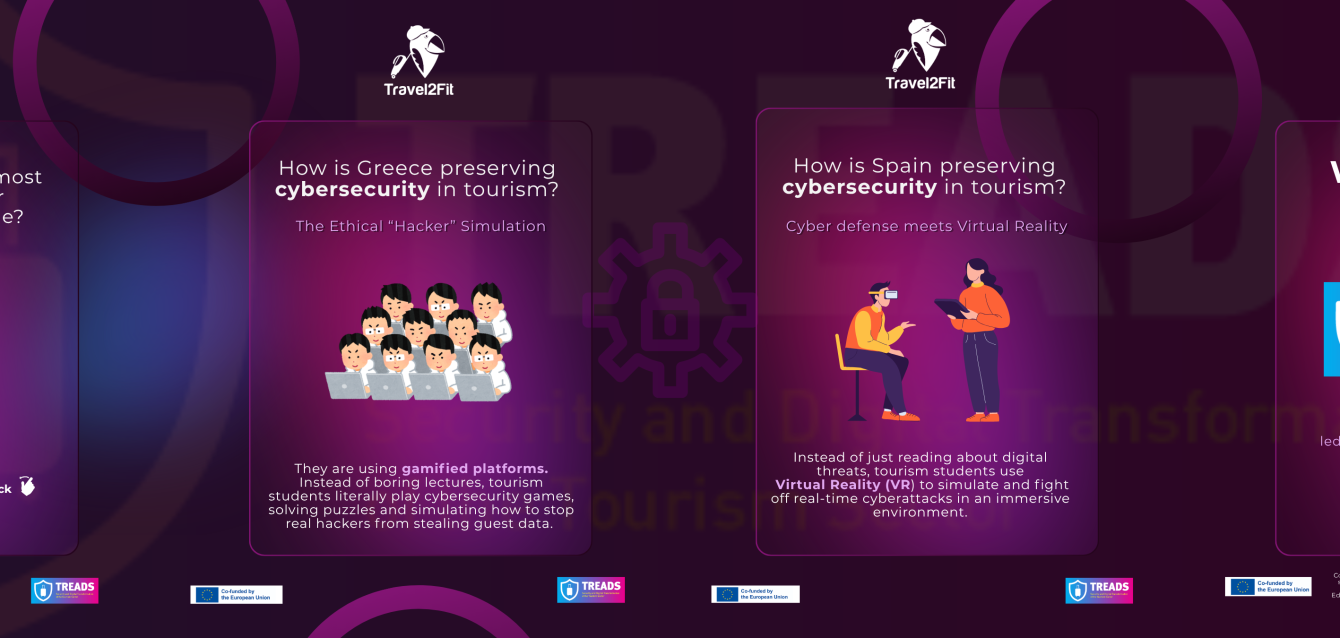
- Spain & Virtual Reality: Through innovation hubs like Tknika, Spain is taking training to the next level. Instead of reading manuals, tourism students don VR headsets to simulate and fight off real-time cyberattacks in an immersive environment.
- Greece & Gamification: Educators are using interactive platforms like TryHackMe and IBM SkillsBuild. They turn digital defense into a puzzle-solving game, making learning highly addictive and effective.
- Italy & On-the-Job Shielding: Organizations like ENAIP Lombardia push a “learning by doing” culture, bringing live, hands-on training directly onto the hotel floor to secure daily operations.
- Continuous Micro-learning: Traditional, one-off training is dead. Short, frequent training modules on phishing and data privacy yield far better results for busy travel teams.
- 📈 European Quality Standards (EQAVET): To be truly effective, training must align with European standards like EQAVET. This way, the skills learned are validated, measurable, and highly professional.

Building the Future of Secure Tourism
Last but not least, as lead partner on this research, we are committed to moving beyond theory. The insights we’ve gathered are paving the way for the TREADS Best Practices Handbook and a brand-new curriculum designed to create the “Upskilled and Resilient Digital Tourism Expert”. Digital resilience isn’t just about preventing breaches. It’s about building trust with your guests and ensuring your business stays innovative in a challenging global market.
👉 Want to learn more about the TREADS project and how these practices can transform your business?
Explore more on the TREADS website: treadsproject.eu
Co-funded by the European Union. The opinions and views expressed are solely those of the author(s) and do not necessarily reflect those of the European Union or the Spanish Service for the Internationalization of Education (SEPIE). Neither the European Union nor the granting authority can be held responsible for them.